Home Management - Book Review
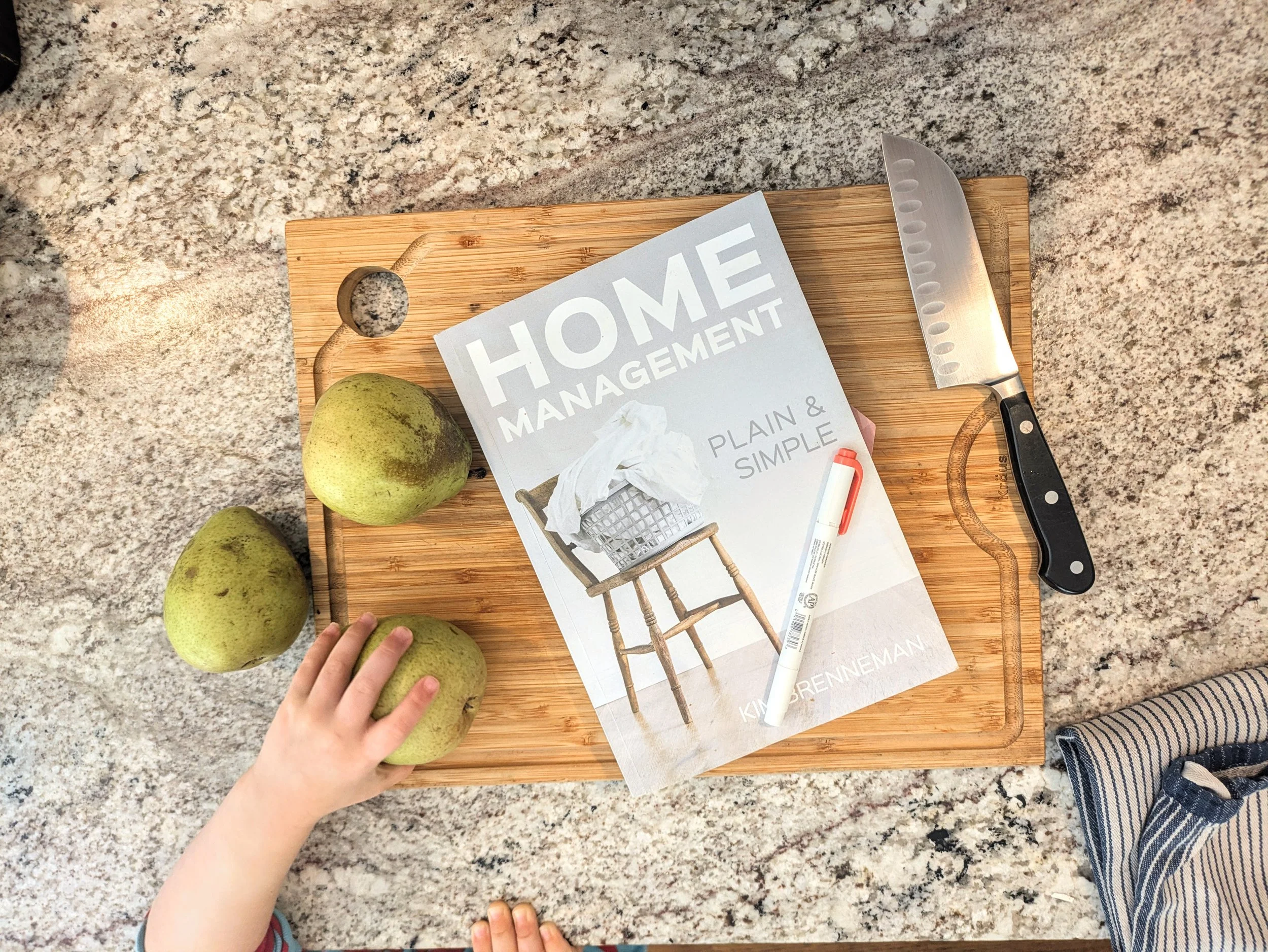
Summary of Home Management: Plan and Simple by Kim Brenneman
Home Management by Kim Brenneman is a Christian-based book about how to manage a home well. This highly detailed book has individual chapters for managing each area of the home. Brenneman also includes chapters on topics to help mamas, such as: baby balance, teaching a chore, and the interrupted day. Home Management uniquely tackles the difficulties of caring for a home from a Christian perspective.
It is a practical manual designed to help individuals transform their households from places of chaos into orderly, peaceful environments. Drawing from her experience managing a large family, Brenneman focuses on the idea that home management is a skill that can be learned through discipline and the implementation of repeatable systems.
Home Management is an excellent book for small groups to read together and discuss the how to improve their home systems.
Inside the Book
Book Size
Book Size: 49 chapters, 352 pages
Average Page Count per Chapter: 4 pages
Audiobook: no
Discussion Questions:
This book does not have discussion questions at the end of each chapter or in the back of the book. However, there is a separate study guide that includes devotionals and worksheets.
Video: no video associated with this book
What I Liked Best
My small group loved this book so much that we read it twice. I really liked her attitude-first approach to caring for a home. She has multiple chapters in the beginning of the book that talk about attitude and perspective. It was pleasantly surprising to find Bible verses and Christian advice mixed into the chapters. I would have never thought to look for a Christian based book about home management.
I loved that she had so many small chapters dedicated to the things that can cause us frustration. It made it easy to quickly find answers and advice to the things that are causing the most pain at the moment.
This book includes lots of chapters and advice sprinkled throughout on including children in chores. Most of the content I have consumed around home management focuses on the work that you as an the primary caretaker should do. But, Home Management: Plain and Simple puts a strong emphasis on housework being a team effort. She has lots and lots of examples of how to include children of any age in chores.
The chapters on laundry have helped my small group conquer the laundry monster. While we are far from perfect, all of us found unique ways to manage our laundry systems that worked well for our families. Mastering laundry was one of our biggest pain points in managing our home. It is worth a read just for this aspect alone.
Some of my favorite quotes:
“Starting the day with God and with the calm of the dawn is a great way to build strength and vigor so that you can in turn bless others.” (page 222)
“Setting clearly-defined goals is an important first step towards faithful stewardship of our time and resources. It helps us to know what to deliberately aim for, rather than haphazardly reacting to our circumstances. We move forward instead of settling for a fatalistic attitude.” (page 12)
“Five minutes here and there in the day on the simple tasks helps to keep on the bright side of things. Putting my eyes on that one clean spot can make a big difference in a disruptive day. Action is a choice towards a better day.” (page 34)
“Days do not always go as planned. The constant barrage of interruptions have the ability to upend a day. Sometimes you can recover. Sometimes you need to spread a task out through the week to get back on track. And sometimes it’s one thing after the other, and life spirals into chaos. You lose. Or at least it appears that you lose, but in reality God gives many lessons in trials.” (page 50)
What I Didn’t Like
This is a BIG book with a lot of chapters. This is not necessarily a bad thing. However, it is not practical to read the entire book as one study for most groups. Even if you read five chapters a week, it would take 10 weeks to complete. Our small group solved this problem by only covering the chapters that were most relevant to our individual struggles.
Brenneman lives a unique life. She has nine children and lives on a farm. The women in my small group had a hard time relating to some of the advice in her book. We were not dealing with the challenges of balancing a large family, home schooling teenagers, and cooking big meals three times a day, all while balancing a baby on our hip. At the beginning of the study, I warned our group that there were things in this book that would not be relevant to everyone. In fact, there are some things Brenneman says that sound downright crazy to a working mom. My advice to you and to them is this: take what is helpful and leave the rest.
How to Organize Your Study
This book has 49 chapters. It covers a lot of topics, some of which might not be relevant to your group. Below you will find my recommendation of how to structure your study. This reading plan gives you the best of the book without being bogged down.
Week 1 - Read Chapters 1-3
Week 2 - Read Chapters 4-7
Week 3 - Choose 2-3 chapters to read OR Read Chapters 18, 22, 35
Week 4 - Choose 2-3 chapters to read OR Read Chapters 19 & 28
Week 5 - Choose 2-3 chapters to read OR Read Chapters 10, 33, 26, 30, 40
Week 6 - Choose 2-3 chapters to read OR Read Chapters 27, 31, 39, 41
Choose Your Topics
For the weeks that you pick your topics, ask the group what topics they are most interested in. Do this the first week of the study. Try to group together chapters that make sense together.
For the Leader: Communicate to your group that the goal of reading this book is to improve your home management. It is NOT: do everything exactly how Kim Brenneman does it. There will be things in this book that don’t make sense for every family or every house. Use the chapters in this book as a backdrop to conversations and solutions to the unique problems of each individual household.
Have each group member identify a specific area that they want to improve on. This will help reduce the overwhelm by encouraging them to focus on what needs the most work, rather than trying to change all of their systems at once.
Recommendation
Home Management: Plain and Simple is good for newly married groups, women’s groups with young children, and any group who wants to collectively improve their home management. Brenneman’s books is an excellent reference that can be pulled out long after the study has ended. Anytime I feel my household slipping into chaos, I reach for this book to remind myself how to pull it back together with sustainable systems.
More Posts: